


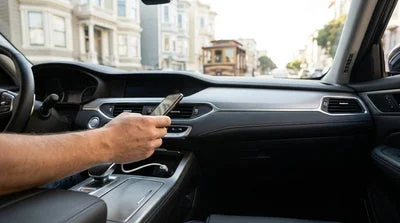
Quick Summary:
- Expect a mix of USB‑A and USB‑C, depending on vehicle year.
- Bring USB‑C to USB‑C and USB‑A to USB‑C cables.
- Pack a 12V cigarette-lighter charger as a reliable backup option.
- Check the centre console and rear seats for extra charging ports.
Picking up a car hire in San Francisco and realising your phone is on 8% is a very particular kind of stress. The practical question is whether rental cars “usually” have USB‑C at pick-up, and the honest answer is: sometimes, but not consistently enough to rely on it. San Francisco fleets are mixed, with newer model years increasingly offering USB‑C, while plenty of perfectly common vehicles still provide USB‑A and a 12V socket instead.
This matters because your cable choice, your sat-nav habit, and even whether you’re using Apple CarPlay or Android Auto all affect how quickly your phone charges. Below is what you can generally expect in San Francisco, and what to pack so you are covered regardless of which vehicle category you receive.
What charging ports are common in San Francisco rental cars?
Most car hire vehicles you collect around San Francisco will have at least one of these: a 12V socket (the old “cigarette lighter” outlet), one or more USB‑A ports, and in newer cars, one or more USB‑C ports. The complication is that fleets are updated gradually, and trims differ even within the same model. A compact from one year might have USB‑A only, while the same badge a year later has USB‑C in the front and rear.
As a rule of thumb, expect USB‑A to be the most common dedicated port in mainstream categories. USB‑C is increasingly frequent in 2022 onwards vehicles, especially in premium trims and some SUVs. The 12V socket remains the most reliable “it will almost certainly exist” option, even if it’s tucked in the centre console or low in the dash.
If you are picking up at the airport, you may be collecting after a flight when you want charging immediately. If you are arranging car hire at San Francisco Airport, it is sensible to assume you could receive anything from a basic USB‑A setup to a modern USB‑C layout, depending on availability and model year that day.
USB‑C at pick-up, what “usually” means in practice
USB‑C is no longer rare, but it is not universal. Many renters report finding USB‑C in newer SUVs and full-size sedans, while economy and older intermediate cars can still be USB‑A only. Some vehicles also have a mix, such as USB‑A in the front and USB‑C in the rear, or vice versa.
Another important detail: not all USB ports behave the same. Some are data ports intended for CarPlay or Android Auto, others are charge-only. Some charge at low power, which can feel like your phone is barely gaining battery if you are running maps, music, and bright screen settings. In other words, even if you do find USB‑C, you may still prefer a dedicated 12V fast charger for consistent performance.
If you are comparing options for car hire in San Francisco SFO versus a city pick-up, the port situation is similar because vehicles rotate. The best preparation is the same either way: carry the cables and a backup power source that fits multiple port types.
What to pack for hassle-free charging
For San Francisco car hire, the goal is to cover USB‑C, USB‑A, and 12V with minimal kit. These are the items that give you the best odds of being able to charge immediately, regardless of the car you receive.
1) USB‑C to USB‑C cable
This is essential if your phone uses USB‑C (most Android phones, newer iPads, many power banks) and the car has USB‑C. It can also support faster charging when paired with a higher-power port, though not all in-car USB‑C ports provide high wattage.
2) USB‑A to USB‑C cable
This is the “fleet coverage” cable. USB‑A remains widespread in rental vehicles, and this cable ensures you can charge a USB‑C phone from an older USB‑A port.
3) USB‑A to Lightning cable
If you use an iPhone with a Lightning port, this is still the most compatible cable for in-car USB‑A ports. Even when a car has USB‑C, it may have only one port or that port may be in use for data.
4) 12V fast charger with both USB‑C and USB‑A outputs
This is the single most reliable way to get strong charging in nearly any rental car, because the 12V socket is common and a quality adapter can deliver stable power. Choosing one with both outputs means your passenger can charge too, and you are not dependent on the car’s built-in port types.
5) A short spare cable
Cables fail more often than ports. A short backup cable takes little space and can save time if your main one is damaged or intermittent.
Where to look in the vehicle for ports
At pick-up, it is worth doing a quick scan before you set off. Ports are not always where you expect, especially if you are used to your own car. Check the area beneath the infotainment screen, the front of the centre console, and inside the centre console storage bin. Some cars have ports for rear passengers on the back of the centre console, and some have extra USB ports inside the armrest or in the boot area.
If you cannot find a USB port quickly, look for the 12V socket. It may be covered by a small cap, or located low in the console. Using a 12V adapter is often faster than searching for the “right” USB port, especially if you are leaving a busy rental facility and want to get on the road.
Charging vs connectivity, CarPlay and Android Auto
If you want wired CarPlay or Android Auto, pack a cable suited to both your phone and the likely port types. A USB‑A to Lightning cable is still common for iPhones, while USB‑A to USB‑C covers many Android devices. If your phone and the car both support USB‑C, USB‑C to USB‑C is simplest, but again, it depends on the specific vehicle you receive.
If you are collecting outside San Francisco, you will see similar variety. For example, travellers arranging car hire in San Jose SJC will encounter the same mix of model years, with USB‑C more likely in newer vehicles but not guaranteed.
Do different vehicle types affect port availability?
Yes, but not in a way you can treat as certain. Larger, newer vehicles and higher trims are more likely to include USB‑C, more total ports, and sometimes rear-seat charging. Vans often have multiple ports because they are designed for more passengers, but the ports can still be USB‑A, depending on the model year.
If you are hiring a larger vehicle for a group, van hire at San Francisco SFO can mean more charging points overall, but you should still bring the same cable set because port types vary widely across van models.
Brand can also influence what you see, because different manufacturers moved to USB‑C at different times. Even within one brand, the exact trim dictates port count and type. If you are browsing options that include a specific provider, such as National Car Rental at San Francisco SFO, treat USB‑C as a bonus rather than a promise, unless your confirmation explicitly states it, which is uncommon.
Bottom line for San Francisco car hire
Do rental cars usually have USB‑C ports at pick-up in San Francisco? Increasingly, yes, but not reliably enough to assume. The most dependable approach is to pack for three possibilities: USB‑C, USB‑A, and 12V. With two cables and a compact 12V charger, you will be able to charge your phone in almost any rental vehicle you receive, and you will avoid wasting time at the kerb trying to find the “right” port.
FAQ
Do San Francisco rental cars always include USB‑C?
No. Some newer vehicles have USB‑C, but many still have USB‑A only, plus a 12V socket.
What is the safest single item to bring for charging?
A 12V fast charger with USB‑C and USB‑A outputs, because most cars have a 12V socket.
If the car has USB ports, will they charge quickly?
Not always. Some in-car USB ports are low power, especially older USB‑A, so charging can be slow while using maps.
Where are charging ports usually located in a rental car?
Common spots include under the infotainment controls, inside the centre console, and on the rear of the centre console for back-seat passengers.
Can I use the USB port for both charging and CarPlay or Android Auto?
Sometimes. Many cars have one dedicated data port for phone integration, while other ports may be charge-only.





























































































